How to Parallel Park: A Repeatable Method
The short answer
- Parallel parking becomes repeatable when you use the same slow setup, observation checks, steering sequence, and final correction every time.
- Reference points depend on the vehicle, so practice in the same car you plan to use for the test when possible.
- States differ on whether the maneuver is tested and how it is scored; your state's road-test page controls.
By the DMV Prep editorial team · Published 2026-08-12 · updated 2026-08-23 · sources last checked 2026-08-12 · Editorial policy
Parallel parking feels difficult because three jobs happen at once: you control the car in reverse, judge space through mirrors and windows, and keep checking for traffic. The solution is not one magic mirror marker. It is a slow routine that separates those jobs into decisions you can repeat.
Before you move
- Choose a legal practice area with a licensed supervising driver and low traffic.
- Use cones or other soft markers before practicing between vehicles.
- Adjust the seat and mirrors before the first attempt and keep that position consistent.
- Know how quickly the car moves at idle and where its front corners swing when reversing.
A repeatable parking sequence
- Signal and stop parallel to the vehicle or front marker, leaving enough side clearance for the front corner to swing.
- Check mirrors, the relevant blind spot, and the space around the car before selecting reverse.
- Reverse slowly while steering toward the space. Keep observing through the rear window and mirrors instead of staring at one marker.
- As the rear enters the space, unwind the steering so the car continues back without the front swinging too far into traffic.
- Steer the opposite way to bring the front into the space, still moving at walking speed.
- Straighten the wheels and make a controlled correction if needed. Finish parallel, centered, and without touching a curb or marker.
Exact test geometry and adjustment rules are not national. Pennsylvania publishes a defined test space and adjustment limit; Washington publishes its own maneuver expectations. Treat any universal cone measurement as a practice aid, not as your state's scoring rule.
What examiners can observe
The finished position matters, but so does how you get there. Official state guidance commonly emphasizes observation, vehicle control, signaling, safe speed, and avoiding contact. A technically neat parking job can still be unsafe if you skip the traffic check or let the front of the car swing without observation.
Practice by fixing one error at a time
- Too far from the curb: begin from a consistent setup and let the rear travel farther into the space before counter-steering.
- Front remains outside: delay straightening or use the allowed correction without rushing.
- Rear reaches the curb early: reduce the initial steering angle or begin unwinding sooner.
- Repeated loss of position: slow down. More time creates more chances to observe and correct.
Check whether and how your state tests parallel parking
Sources
- Pennsylvania Driver's Manual — Chapter 1: Testing ↗ (checked 2026-08-12)
- Washington DOL — What to Expect on Your Drive Test ↗ (checked 2026-08-12)
Check yourself
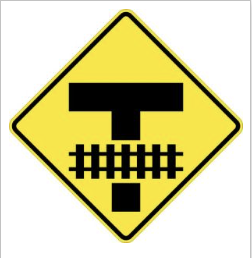
This round yellow sign warns that:
- A. A railroad crossing is ahead
- B. A low bridge is ahead
- C. A gas station is ahead
- D. The road merges with a highway ahead
Show answer
A. A railroad crossing is ahead — This is the advance warning sign for a railroad crossing, placed before the crossing itself to give drivers time to slow down and prepare to stop if a train is coming.
Universal rule · checked against MUTCD 11th Edition, Part 2 — Signs (General) — Traffic Signs — General · verified 2026-08-01

Frequently asked questions
Do all states test parallel parking?
No. Test content varies, and a state may use another backing or parking maneuver. Check the current road-test page for your jurisdiction.
Can I use parking-assist features during the test?
Rules vary. Pennsylvania permits an equipped vehicle but requires the self-parking feature to remain off; Washington also says to park without parking-assist features. Confirm your state's rule.
Should I memorize one mirror reference point?
Use reference points only after calibrating them to your seat position and vehicle. Observation and slow control matter more than one marker copied from another car.
What should I practice first?
Start with slow reverse control and observation around soft markers. Add the full steering sequence after you can move and stop precisely.