Road Test Practice: A Better Rehearsal Plan
The short answer
- Separate learning from testing: coach one skill at a time, then run a silent mock drive.
- Record observable behavior rather than vague impressions such as good or nervous.
- Build the mock from your state's published documents, vehicle checks, and maneuvers.
By the DMV Prep editorial team · Published 2026-08-12 · updated 2026-08-23 · sources last checked 2026-08-12 · Editorial policy
Hours behind the wheel help, but unstructured driving can repeat the same habits without exposing them. Effective road-test practice alternates focused drills with realistic mock tests. The drill teaches; the mock reveals whether the behavior survives without reminders.
Build the checklist from your state
Start with the state's own road-test page, not a national maneuver list. Copy only what the agency publishes: documents, vehicle equipment, pre-drive controls, observed behaviors, parking or backing maneuvers, and any stated critical errors. If a detail is absent, do not turn a common practice item into an alleged state requirement.
Use three practice modes
- Focused drill: repeat one behavior in a safe setting, such as complete stops, blind-spot checks, smooth braking, lane changes, or a published parking maneuver.
- Mixed route: combine several behaviors in normal traffic while the supervising driver coaches only when needed for safety or instruction.
- Mock test: begin with documents and vehicle controls, then drive without coaching while the supervisor records observable misses.
Give feedback an examiner could use
Replace labels with observations. Instead of saying the turn was bad, record that the signal began after braking, the blind spot was not checked, the car crossed the lane line, or the turn ended in the wrong lane. Specific feedback produces a specific next drill.
- Observation: mirrors, shoulder checks, intersections, pedestrians, signs, and hazards.
- Communication: timely signals, brake-light cues, lane position, and predictable decisions.
- Control: smooth acceleration, braking, steering, backing, and stopping position.
- Rules: right-of-way, complete stops, speed choice, lane use, and yielding.
- Test-day readiness: documents, legal supervision, and every vehicle item named by the state.
When to repeat a full mock
Do another mock after the previous pattern has been drilled, not immediately after every mistake. A useful readiness signal is consistency across different routes and traffic conditions without prompts. One clean drive on a memorized route is weaker evidence than several controlled drives with new decisions.
Build practice from your state's road-test guide
Sources
- Washington DOL — What to Expect on Your Drive Test ↗ (checked 2026-08-12)
- Texas DPS — How to Prepare for a Drive Test (DL-60) ↗ (checked 2026-08-12)
Check yourself
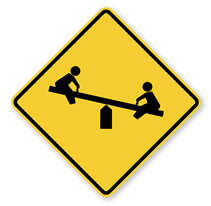
This playground warning sign means:
- A. A school zone begins in one mile
- B. A playground area is nearby and children may be present
- C. Pedestrians are prohibited from crossing here
- D. A park entrance requires a permit
Show answer
B. A playground area is nearby and children may be present — A playground sign warns drivers that children may be playing near the roadway, so they should slow down and watch closely for kids entering the street.
Universal rule · checked against MUTCD 11th Edition, Part 2 — Signs (General) — Traffic Signs — General · verified 2026-08-01

Frequently asked questions
How should I practice for a road test?
Alternate one-skill drills, mixed normal driving, and silent mock tests built from your state's published criteria.
Should my supervising driver coach during a mock test?
Only when safety requires intervention. Otherwise, the supervisor should record observable behavior and discuss it after the car is parked.
Should I memorize the test route?
No. Practice the road types and decisions your state tests. A memorized route does not prove you can handle a different traffic gap, signal, or hazard.
How do I know what maneuvers to practice?
Use your state's current road-test page. Do not assume a maneuver is required because another state or a driving school includes it.