DMV Behind-the-Wheel Test: What to Expect
The short answer
- The appointment usually has four parts: document check, vehicle check, supervised drive, and results discussion.
- The examiner evaluates observable safe-driving behaviors and gives route directions; the job is not to trick you.
- Documents, vehicle equipment, maneuvers, scoring, and retest rules vary by state, so use the state guide before test day.
By the DMV Prep editorial team · Published 2026-08-12 · updated 2026-08-23 · sources last checked 2026-08-12 · Editorial policy
The behind-the-wheel test is the practical part of licensing: an examiner rides with you while you demonstrate legal, controlled driving in real traffic or on a state-approved course. Knowing the sequence removes much of the uncertainty, but the exact checklist still belongs to your state.
1. Check-in and documents
Before anyone enters the car, staff may review your permit, appointment, identity or training documents, vehicle registration, and insurance. The required set differs sharply by jurisdiction and age. Bring the originals or accepted electronic versions named by your state; a generic national checklist cannot substitute for that page.
2. Vehicle safety check
The examiner can inspect equipment before beginning. Washington publishes checks for items such as lights, signals, seat belts, plate, parking brake, windshield, doors, mirrors, and weather-dependent equipment. Pennsylvania warns that an unsafe vehicle or one that does not meet inspection requirements will not be tested. Your state may publish a different list.
3. Examiner directions and observed driving
Once the test starts, the examiner tells you where to drive and which maneuvers to perform. Washington states plainly that examiners do not try to confuse candidates or ask them to do anything illegal. Texas's official checklist emphasizes mirrors and shoulder checks, complete stops, correct lanes, signals, right-of-way, speed control, and smooth steering and braking.
- Listen to the full direction, then make the maneuver only when it is legal and safe.
- Keep scanning even when the route seems simple; observation is visible behavior.
- If a direction is unclear, ask the examiner to repeat it rather than guessing.
- If you miss a turn, continue safely. Do not make an abrupt or illegal correction to follow the route.
4. Results
After the drive, the examiner explains the result and any next step. What counts as an immediate failure, how other errors are scored, whether you receive a score sheet, and when you may retest are state decisions. Treat feedback as a practice plan, especially when several deductions point to the same observation or control habit.
Behind-the-wheel requirements by state
Sources
- Washington DOL — What to Expect on Your Drive Test ↗ (checked 2026-08-12)
- Texas DPS — How to Prepare for a Drive Test (DL-60) ↗ (checked 2026-08-12)
- Pennsylvania Driver's Manual — Chapter 1: Testing ↗ (checked 2026-08-12)
Check yourself
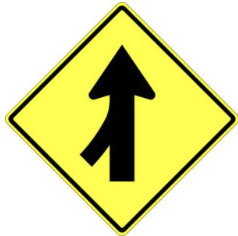
This merge-arrow sign means:
- A. The lane you are in is ending and traffic must merge left
- B. A new lane is opening on the left
- C. Left turns are prohibited ahead
- D. Two-way traffic begins ahead
Show answer
A. The lane you are in is ending and traffic must merge left — A merge-left sign warns that the current lane ends ahead, so drivers must safely merge into the lane to their left before it disappears.
Universal rule · checked against MUTCD 11th Edition, Part 2 — Signs (General) — Traffic Signs — General · verified 2026-08-01

Frequently asked questions
What is the behind-the-wheel test?
It is a practical licensing test in which an examiner observes you operating a vehicle legally and safely while following route and maneuver directions.
Does the examiner try to trick you?
No. Washington DOL explicitly says the examiner will not try to confuse you or ask you to do anything illegal. Ask for a repeated direction when needed.
Can the test end before I start driving?
Yes. Missing required documents or bringing a vehicle that fails the state's safety check can prevent the drive from beginning.
Are the maneuvers the same in every state?
No. States publish different maneuver lists, course designs, scoring methods, and vehicle rules.