Driving Test Tips That Match What Examiners Check
The short answer
- Make safety checks visible: mirrors, blind spots, intersections, signs, pedestrians, and traffic gaps.
- Choose legal, predictable actions over rushed attempts to follow a direction perfectly.
- Use your state's checklist because maneuver, vehicle, document, and scoring rules are not national.
By the DMV Prep editorial team · Published 2026-08-12 · updated 2026-08-23 · sources last checked 2026-08-12 · Editorial policy
Useful driving-test advice should map to something an examiner can observe. Official state materials repeatedly describe the same core behaviors: scan, signal, stop completely, choose the correct lane, yield correctly, control speed, and operate the vehicle smoothly. Build your final practice around those actions, then add the maneuvers your own state publishes.
Before test day
- Read the state's road-test page again, including documents and vehicle equipment.
- Practice in the test vehicle so controls, mirrors, braking response, and sight lines are familiar.
- Drive the likely road types, not a memorized test route: residential streets, controlled intersections, lane changes, and parking areas.
- Ask a supervising driver to mark only visible behaviors, not give constant verbal coaching.
Make observation visible
A glance that happens only with your eyes can be hard to distinguish from no check at all. Use normal head movement for mirrors, blind spots, cross traffic, and pedestrians. Texas tells candidates to check mirrors regularly and look over the proper shoulder when necessary; Washington includes scanning and head checks in its published test behaviors. Do not exaggerate the motion so much that you stop watching the road ahead.
Finish each basic action
- Stop completely at the correct line before creeping forward for visibility.
- Signal early enough to communicate, then cancel the signal after the maneuver.
- Enter and finish turns in the correct lane without cutting or swinging wide.
- Reach an appropriate speed smoothly and adjust it for traffic, weather, light, and sight distance.
- Leave a safe following gap instead of matching the car ahead too closely.
Treat directions as route guidance, not permission
The examiner's direction never overrides signs, signals, lane markings, right-of-way, or safety. If traffic blocks a lane change or turn, wait. If you miss the requested street, continue safely and let the examiner redirect you. One wrong turn is less serious than an unsafe correction.
After one mistake
Do not grade yourself while the car is moving. Return attention to the next observation and control task. States score differently, and you usually cannot know from the driver's seat whether an action earned a deduction or how much it matters. Safe recovery is itself better driving than panic.
Use the checklist for your state
Sources
- Texas DPS — How to Prepare for a Drive Test (DL-60) ↗ (checked 2026-08-12)
- Washington DOL — What to Expect on Your Drive Test ↗ (checked 2026-08-12)
Check yourself
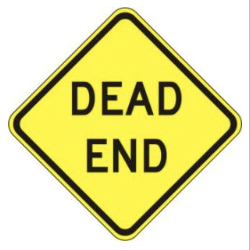
This yellow DEAD END sign warns that:
- A. A one-way street begins ahead
- B. The road ahead is closed for construction
- C. The road ends ahead with no through passage
- D. The speed limit drops sharply ahead
Show answer
C. The road ends ahead with no through passage — A dead-end sign warns that the road terminates ahead and does not connect to another road, so drivers should be ready to stop or turn around.
Universal rule · checked against MUTCD 11th Edition, Part 2 — Signs (General) — Traffic Signs — General · verified 2026-08-01

Frequently asked questions
What is the most important driving-test tip?
Make safe observation consistent and visible. Check mirrors, blind spots, intersections, signs, pedestrians, and traffic before each decision.
What if I miss the examiner's turn?
Continue safely and allow the examiner to redirect you. Do not make a sudden or illegal maneuver to recover the route.
Should I drive unusually slowly during the test?
No. Follow posted limits and choose a reasonable speed for traffic, weather, light, and sight distance. Driving too slowly can also be unsafe.
Can one small mistake fail the test?
Scoring varies. Do not assume an ordinary mistake ended the test; refocus on the next safe action unless the examiner tells you otherwise.