Right of Way
Master intersections, pedestrians, and who goes first.
Most missed rules in this lane come from movement order, not memorizing one exact picture. Focus on four-way stops, uncontrolled intersections, turns across traffic, crosswalks, railroad crossings, and emergency vehicles so you can explain who yields, who proceeds, and what changes when a pedestrian or train enters the scene.
The rules that matter
- Right-of-way is something you give, never something you take. The rules say who must yield, not who may go.
- At a four-way stop the first to arrive goes first. If two arrive together, the driver on the right goes first.
- At an intersection with no signs or signals, yield to any vehicle already in it and to the vehicle on your right.
- Turning left across traffic, you yield to oncoming vehicles and to pedestrians in the crosswalk. A green light does not change that.
- In a roundabout, yield to traffic already circulating, then enter and travel to the right.
- Pull to the right and stop for an emergency vehicle using lights or siren, and never follow one closely.
- A pedestrian with a white cane or a guide dog always has the right of way — stop and wait.
The lessons in this module
Each lesson is one short set of questions. If you've missed questions in this module before, a few come back at the start. Progress saves automatically; sign in only if you want cross-device sync.
Lesson videos
15 lessons · See all →Read this in the handbook
Look for these sections: Right-of-Way, Intersections, Pedestrians, Emergency Vehicles, Railroad Crossings.
Where these rules come from
We do not copy official handbooks — most states do not allow it. What we do instead: state the rule in our own words, then name the official document behind it. 255 questions in this module cite 71 official documents, none checked earlier than 2026-05-17. The 6 most-cited are below.
| Official document | Sections cited |
|---|---|
NHTSA Ten Tips for Safe Driving ↗ National · Checked 2026-08-01 | Safe Driving Basics |
NHTSA Pedestrian Safety ↗ National · Checked 2026-08-01 | |
MUTCD 11th Edition, Part 8 — Railroad and Light Rail Grade Crossings ↗ National · Checked 2026-08-01 | Railroad Crossings |
FHWA Roundabouts: An Informational Guide ↗ National · Checked 2026-08-01 | |
MUTCD 11th Edition, Part 4 — Highway Traffic Signals ↗ National · Checked 2026-08-01 | Pedestrian Signal Indications, School Zone Beacons |
State driver handbook (universal rules of the road) ↗ National · Checked 2026-06-14 | Rules of the road - visual scenario |
Opening a source takes you to the agency's own site, never to a copy of ours. If a source is out of date or broken, say so from any question.
Practice this module
Instantly graded questions, with the explanation behind every answer.
Keep using the focused drill, or choose Marathon to work through the full bank.
Keep practising here
The free app adds offline study and native reminders; the complete question bank remains available here on the web.


Review these questions
In a multi-lane roundabout, to go straight you should:
- A. Use either lane
- B. Use the right lane
- C. Use the left lane
- D. Use the center lane
Show answer
A. Use either lane — To go straight through a multi-lane roundabout, you may generally use either lane. Check signs for specific lane assignments.
Universal rule · checked against FHWA Roundabouts: An Informational Guide · verified 2026-08-01
Before crossing a railroad track after a train passes, you should:
- A. Immediately proceed — the train just passed and the crossing is clear
- B. Wait and look both ways
- C. Count 5 seconds, then proceed
- D. Proceed as soon as the gate begins to rise
Show answer
B. Wait and look both ways — After a train passes, look in both directions before crossing. Another train could be approaching on the same or a parallel track. Wait for gates to fully rise and signals to stop before proceeding.
Universal rule · checked against MUTCD 11th Edition, Part 8 — Railroad and Light Rail Grade Crossings — Railroad Crossings · verified 2026-08-01
To make a proper right turn at an intersection, you should:
- A. Turn from the center lane
- B. Swing wide to the left before turning
- C. Approach near the curb, turn into the nearest lane
- D. Make the turn as wide as possible
Show answer
C. Approach near the curb, turn into the nearest lane — A correct right turn starts close to the right curb and ends in the nearest right lane, keeping the turn tight and predictable.
Universal rule · checked against NHTSA Ten Tips for Safe Driving — Safe Driving Basics · verified 2026-08-01
A pedestrian is jaywalking across the road mid-block ahead of you. You should:
- A. Maintain speed since they are crossing illegally
- B. Slow down; you must still avoid a collision
- C. Swerve sharply into the next lane
- D. Honk and keep going without slowing
Show answer
B. Slow down; you must still avoid a collision — Even when a pedestrian crosses illegally, you must do what you safely can to avoid hitting them, including slowing or stopping.
Universal rule · checked against NHTSA Pedestrian Safety · verified 2026-08-01
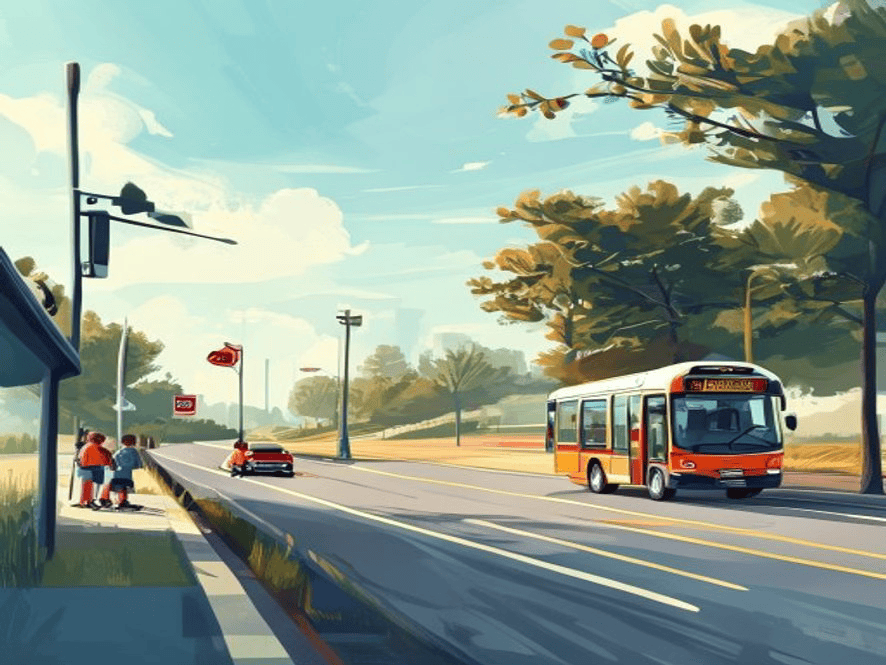
Children are gathered at this bus stop near the road. As you pass, you should:
- A. Maintain speed since they are off the road
- B. Slow down and be ready to stop for a child
- C. Honk to keep them back
- D. Move to the far lane and speed up
Show answer
B. Slow down and be ready to stop for a child — Children near the road can step out unexpectedly, so reduce speed and stay ready to stop when passing a bus stop or play area.
Universal rule · checked against State driver handbook (universal rules of the road) — Rules of the road - visual scenario · verified 2026-06-14
